




|
Virtue Ethics |

|
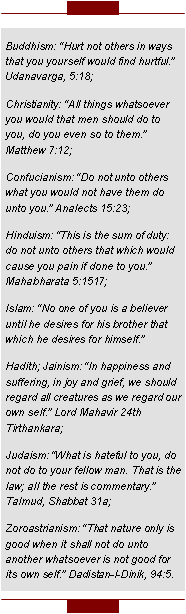
Human society has ethical and moral norms based on wisdom, conscience, and practicality. Many norms are universal and have withstood the test of human experience over long periods of time. One such principle is that of reciprocity. It is often called the Golden Rule: “Treat others as you wish to be treated.” It is an ethical and moral foundation for all the world’s major religions. So first of all, it is inconsistent with moral wisdom and practical common sense for a few states to violate the ancient and universally valid principle of reciprocity. Such moral myopia has a corrosive effect on the law, which gains its respect largely through moral coherence. Global security cannot be obtained while rejecting wisdom universally recognized for thousands of years. Second of all from the ethical perspective of view any kind of weaponry should comply with two main principles: discrimination and proportionality. The first implies that only combatants must suffer from weapon, the second says that the way warfare is conducted may be out of proportion to the reasons the war is waged. The same principles are reinforced in the international law: the rules of armed conflict, including humanitarian law, prohibit the use of any weapon that is likely to cause unnecessary suffering to combatants; that is incapable of distinguishing between civilian and military targets; that violates principles protecting neutral states (such as through fall-out or nuclear winter); that is not a proportional response to an attack; or that does permanent damage to the environment. Takashi Hiraoka, the former Mayor of Hiroshima, described the horrors of nuclear blast, which was indiscriminative to its victims: ‘Beneath the atomic bomb’s monstrous mushroom cloud, human skin was burned raw. Crying for water, human beings died in desperate agony. With thoughts of these victims as the starting point, it is incumbent upon us to think about the nuclear age and the relationship between human beings and nuclear weapons… The unique characteristic of the atomic bombing was that the enormous destruction was instantaneous and universal. Old, young, male, female, soldier, civilian – the killing was utterly indiscriminate. The entire city was exposed to the compound and devastating effects of thermal rays, shock wave blast, and radiation…’ So the use and possession of nuclear weapons is unjustifiable from the point of view of main ethical considerations. Aristotelian Virtue Ethics Considerations The implication of Aristotelian Virtue Ethics in the question of developing nuclear technologies proved that under no circumstances nuclear weapons can be considered as good from this point of view. First of all, for Aristotle there must be one overall or final aim towards which everything else is directed. For Aristotle, that final aim is the Good; not only the good for oneself but the Good for all humanity. However in reality nuclear weapons are held by a handful of states which insist that these weapons provide unique security benefits, and yet reserve uniquely to themselves the right to own them. This situation is highly discriminatory and thus unstable; it cannot be sustained. The possession of nuclear weapons by any state is a constant stimulus to other states to acquire them. Assuming that a particular state is considered as an individual and the humanity as a community the following argument presented by Aristotle in Nichomachean Ethics still holds true: ‘For even if the good of the community coincides with that of the individual, it is clearly a greater and more perfect thing to achieve and preserve that of a community.’ So on the one hand we have a nuclear weapon possessing state, which has a certain virtue of either directly imposing it’s will upon other states or using it as very strong argument when solving it’s political problems and on the other hand we have the humankind which would be better off without any potential threat of nuclear weapons. So, assuming that the possession of nuclear weapons is a virtue for a particular state the last argument to call upon is the following: each virtue is identifiable as a trait that enables it’s possessor to perform its function well under the set of conditions where this function could be relevantly used to full extent. That means that the virtue of possessing nuclear weapon can be only identified through using it. However it’s not true, since a mere possession of nuclear weapons without ever trying to use them would already be considered as a ‘virtue’. |
|
Ethical Argument |




|
Analysing the social and ethical implications of military development |
|
Military Technology Out of Control? |